
Hypnosis consultations for Sports Performance
The penalty shot that shakes, the marathon decided in your head at kilometre 32, the return to play where the healed leg still hesitates…
All else being equal in training, it's the mental side that makes the difference — and the mental side can be trained.
Our hypnotherapists support athletes of all levels across Quebec, in offices or online: from beer-league hockey players to teens in sport-study programs, from Sunday runners to competitors. Mental imagery, handling pressure, routines, returning after injury — as a complement to your training and coaching, never in their place.

Video transcript
How can hypnosis help you to be more concentrated, more efficient in learning, or also more creative? There are at least three levels of action of hypnosis to improve our intellectual or sports performance. And this is not only if you have trouble concentrating or suffer from hyperactivity. The subject of hypnosis and ADD - Attention Deficit Disorder - or ADHD - with hyperactivity - especially in children is a separate topic, which will be the subject of another video. So I come back to your initial wish to be more efficient in your studies, for an exam, or a sports competition. And on these three levels, therapeutic hypnosis is interesting: First of all, hypnosis is a state of very high internal focus.
You create your own bubble and become more focused on your goal. For instance, studies have shown faster reading and better comprehension in school children with the use of hypnosis. In fact, when I have something boring to do, for example a report to write, I put myself in self-hypnosis by mentally programming myself on a time frame: for example, in half an hour, I want to be done. And then I get into my bubble, and it works surprisingly well... Then, you can increase your motivation and your self-confidence thanks to hypnosis, especially by combining NLP techniques under hypnosis. You can make your goal more attractive, change limiting beliefs about the task at hand or about yourself. This can help you avoid procrastination or negative ideas that make you doubt your own abilities.
And also, to get you to work or train more easily and regularly. Finally, and this is particularly useful for exams or sports competitions, hypnosis can help you better manage stress and anxiety before and during the test. Too much stress makes us lose our faculties, and some students even talk about sweating, accelerated heartbeat or an empty brain.... There have been very interesting studies, since the end of the 1960's, on different methods to help students reduce their stress. Hypnosis had good results, better than the tranquilizing drugs that were tested at the time. So, if you want to improve your concentration to work more efficiently, develop your self-confidence or prepare for exams in a more serene way, try therapeutic hypnosis.
Our team of hypnotherapists at Solutions Hypnose are here to help you. Either in person, near you or on video, which also works very well. Make an appointment now to create the life you desire through hypnosis! See you soon.
Hypnotherapy is a complementary form of support and does not replace medical advice, diagnosis, or treatment. If you have any concerns about your health, please consult a physician first.

Sports performance is (almost) as much in the head as in the body
What we train when we train the mind
- Mental imagery: rehearsing without skating. Mentally living through your movement in a rich, sensory way largely activates the same brain circuits as the real execution: rehearsing in your imagination is genuinely training. Hypnosis intensifies the vividness of these images and builds in the state you want (calm, controlled intensity, confidence…) so the movement and the state arrive together on game day.
- The activation zone: switched on without being overwhelmed. Pre-competition stress isn't an enemy, it's energy to be dosed: too low, you're flat; too high, the movement tightens. We identify your zone, anchor it (breath, gesture, word), and rehearse it in imagery under real conditions (the locker room, the warm-up, the faceoff…) until game day becomes familiar ground.
- Bouncing back from a mistake. A game is rarely lost on a mistake — it's lost on the three shifts that follow. Wiping the slate clean and moving on is a skill: a reset protocol, returning attention to the play at hand, and working on inner dialogue (see Self-Confidence).
- Routines and sleep. The stable sequence that puts body and mind into competition mode. And sleep the night before a game, the athlete's first legal performance enhancer, often sabotaged by pre-game excitement (see Sleep). Self-hypnosis learned in session becomes your portable mental preparation.
For the full mechanics (imagery, the activation curve, inner dialogue) and the sources behind them, see our full guide on solutionshypnose.com.
Returning after an injury: the body heals, the mind has to follow
That said, returning to play has a side that rehab doesn't cover: the fear of re-injury.
The kind that makes you skate "with the handbrake on," avoid the corner, hold back a check. Once medically cleared, our work rebuilds confidence in the healed body part (imagery of full, committed movements), defuses the mental replay of the injury, and supports the patience rehab demands — often the hardest part for a competitive athlete.
The sports we work with most in Quebec
Hockey, running, skiing, sport-study programs
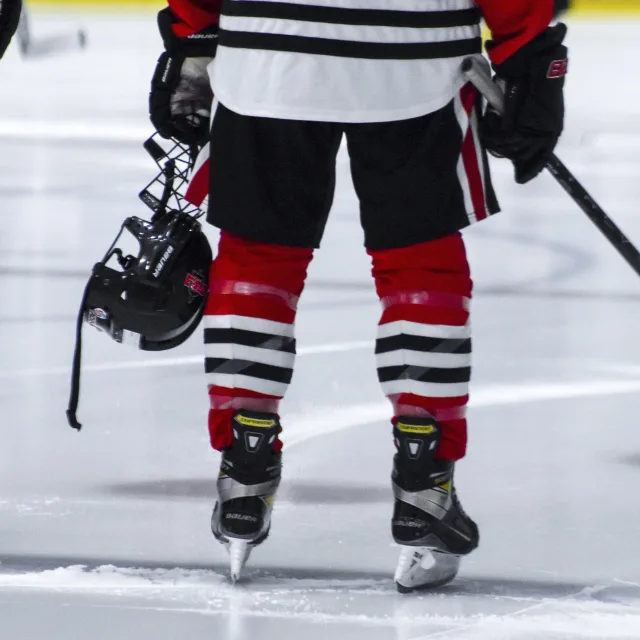
- Hockey. The shootout attempt that feels like a ton of weight, the shift after a mistake, the young player more stressed by scouting than the game itself: from beer league to midget AAA, the hockey mindset can be trained. And for young players, the double pressure of rink and school has its own page, Teens.
- Running and endurance. The Montreal and Quebec City marathons, trail running, triathlons: the dialogue with effort, the wall at kilometre 32, the mental management of long winter training runs — never confusing the discomfort of effort with the pain of injury.
- Skiing and winter sports. The fear after a fall, committing to the slope, the gate that went wrong and keeps replaying.
- Sport-study programs and young athletes. Performance expected at school AND on the ice: the double pressure can be worked on, and well-being comes before results. For young people, Sport'Aide offers a listening ear and support, and our approach follows the same philosophy: a young athlete who is doing well performs better — never the other way around.
- Gym, CrossFit, combat sports. Consistency, plateaus, an approaching competition, returning after a break.
Our framework — and what we won't do
We are relational-support professionals, working alongside your sports and medical team.
We never replace your coach, your physical trainer, or above all your doctor or physiotherapist.
We never promise a time or a win (be wary of anyone who does), we never mask a signal from your body, and we're glad to work alongside your team: preparation works better when everyone is playing the same tune.
What our clients say
« After an injury, I had trouble getting back into training... Loss of motivation, fear of getting hurt again, and at the same time wild ideas about international competitions. I worked on respecting my limits with a gradual training plan, letting go of my focus on titles and deadlines. In short, to rediscover my love for my daily practice. »
Julien
« Rajeanne helped us a lot, my daughter succeeded to perform on a very important final competition and got a first place, becoming a Quebec champion in Juvenile cathegory. L »
Nika, client of Réjeanne LeBlanc
« I consulted Ms. Perez De Leon for anxiety related to my preparation for the Ottawa Marathon in May 2026. Once again, her help was invaluable and allowed me to finish my training well and get excellent results in my race. I highly recommend her if you're dealing with this kind of worry. Thank you Nuria!! »
Denis, client of Nuria Perez de Leon
Consult a Hypnotherapist for Sports Performance Near You
In Office or Online Across Canada
Offices in Montreal, Gatineau, Sherbrooke, Montérégie…
And if you live far away or elsewhere in the world, online sessions work very well. Evening slots available.
All areas
 Annie Mayrand
Gatineau - Cumberland (ON)
👤
🧑🎓
🚭
❤️
💻
Annie Mayrand
Gatineau - Cumberland (ON)
👤
🧑🎓
🚭
❤️
💻
 Christian Rocher
Beloeil
👤
🧑🎓
👶
🚭
❤️
💻
Christian Rocher
Beloeil
👤
🧑🎓
👶
🚭
❤️
💻
 David Veilleux
Montréal - Anjou
👤
🧑🎓
🚭
❤️
🤰
💻
David Veilleux
Montréal - Anjou
👤
🧑🎓
🚭
❤️
🤰
💻
 Florence Aton
Sutton
👤
🚭
❤️
💻
Florence Aton
Sutton
👤
🚭
❤️
💻
 Jessica Reid
Sherbrooke
👤
🚭
💻
Jessica Reid
Sherbrooke
👤
🚭
💻
 Julie Rocque
Montréal - Jean-Talon
👤
🧑🎓
👶
🚭
❤️
🤰
💻
Julie Rocque
Montréal - Jean-Talon
👤
🧑🎓
👶
🚭
❤️
🤰
💻
 Nuria Pérez de León
Montréal - Rosemont - Saint-Lambert
👤
🧑🎓
💻
Nuria Pérez de León
Montréal - Rosemont - Saint-Lambert
👤
🧑🎓
💻
 Romain Rastoin
Bromont
👤
🧑🎓
🚭
❤️
💻
Romain Rastoin
Bromont
👤
🧑🎓
🚭
❤️
💻
 Réjeanne LeBlanc
La Prairie
👤
🧑🎓
👶
💻
Réjeanne LeBlanc
La Prairie
👤
🧑🎓
👶
💻
Frequently asked questions about hypnosis for sports performance
Very much so, it's actually reason number one. A game adds what practice doesn't have: stakes, an audience, the standings. Your activation moves out of its zone, your movement tightens, your head starts commentating instead of playing. We identify your optimal zone, anchor it, and rehearse the game in imagery until it becomes familiar ground. Two to four sessions are often enough.
No, and that's a hard line. Every concussion follows Quebec's official medical protocol, step by step, no shortcuts. What we can support, with the medical team's agreement: the patience the protocol demands (often the hardest part for a competitive teen), and sleep. And once return is authorized, rebuilding confidence on the ice.
Yes, and it's valuable work. An athlete who plays "with the handbrake on" is paradoxically more exposed. Once cleared by a doctor or physio, we rebuild confidence in the healed body part through imagery of full, committed movements, and defuse the mental replay of the injury. The mind has to heal too — that's our part.
Often even faster than for elite athletes: the room for mental improvement is greater. Finishing your first half-marathon without falling apart at kilometre 15, sticking with February's training plan, rediscovering the pleasure of running… The mechanics are the same as at the elite level, only the stakes change.
Far more than compatible: complementary, and we mean that. The coach builds performance. We equip the mind, and we're glad to inform the coaching staff of our framework (with the teen's and parents' agreement). One non-negotiable principle for us: a young athlete's well-being comes before results — and that's precisely when they perform best.
It depends on your group plan. Our practitioners issue receipts (relational support, naturotherapy, or hypnotherapy depending on their affiliation), but not every insurer accepts them: check your policy before your first session.
We are not doctors, physiotherapists, psychologists, or psychotherapists. Our services fall under relational support and well-being: they do not constitute treatment or psychotherapy (a regulated act in Quebec), and never replace medical or rehabilitation care. Any pain or injury must be assessed by a healthcare professional; any concussion requires stopping and following the official medical protocol.

Page written by Ghislain Lepage
hypnotherapist
partner at Solutions Hypnose.
English version reviewed by David Veilleux
Updated .